
A scientific report can remain identical to the day it was issued while the knowledge needed to interpret it changes. Its signature still verifies. The original measurement is still present. A reference record has been corrected, an annotation has moved, or an interpretation rule has been revised. Someone opening the report today needs to know what they can still rely on.
That question reaches across data modeling, computation, publication, and user experience. A single “current” flag has too little meaning to carry it. The useful engineering question is more specific: which outputs depended on the changed information, what kind of dependency was involved, and what should happen before those outputs are used again?
A well-designed system can answer that question without rewriting its past. It can preserve the original evidence, examine the affected conclusions, and explain the basis of the current view.
A report contains several kinds of statement
Consider a fictional report assembled from a laboratory observation, a normalized representation, a derived calculation, and an interpretation. Those layers make different commitments.
The observation records what a particular source reported about particular material. The normalized representation maps that statement into the application's vocabulary. The calculation applies a defined method to selected inputs. The interpretation explains what those observations and calculations mean under an identified body of knowledge.
A correction to one layer need not change every other layer. A source can correct an identifier while leaving a measured value unchanged. A calculation can be reproduced exactly while its interpretation becomes less persuasive. A new rule may alter a displayed conclusion without changing the original result supplied by the laboratory.
Keeping these statements separate gives an update somewhere precise to land. If they are collapsed into one mutable field, the application has to choose between losing the old account and leaving an unexplained discrepancy.
The same distinction helps with user questions. “Was this the report issued then?” asks about an artifact and its history. “Is this interpretation appropriate for my current task?” asks about present applicability. The system should make both questions answerable.
A version identifier has a defined scope
A reference identifier is useful because of the guarantee made by the organization assigning it. That guarantee needs to be understood before the identifier is used as an all-purpose freshness signal.
HGVS ties a variant description to a stable reference sequence. Where a sequence source uses versions to distinguish sequences, the version belongs in the identifier. HGVS reference-sequence requirements establish that naming context; they do not validate an interpretation attached to the variant.
NCBI's identifier documentation also distinguishes sequence changes from minor record updates that need not advance the sequence version. An unversioned accession refers to the latest sequence. GenBank sequence identifiers therefore support a narrower guarantee than “everything about this scientific record is frozen.”
The architectural implication is to identify dependencies at the level the computation actually uses. A system might need a sequence identifier, an annotation release, a retained source artifact, an interpretation-policy version, or several of these. Recording a single URL can leave later reviewers unable to reconstruct which content was consumed.
This is a design decision about the application's reproducibility needs. It should follow the meaning of the source's versioning scheme rather than assume that every upstream system uses the same one.
Capture the dependency at the moment of use
An output is easiest to explain when its production record describes the inputs and rules actually used. Reconstructing that context after an upstream source has changed is a much weaker position.
A practical dependency record can identify the retained input, the transformation applied, the relevant reference context, and the rule version governing interpretation. It can also identify the activity that produced the output and when that activity ran. If the output was reviewed or released, the review and release records can refer to that specific output version.
The W3C provenance model supplies public vocabulary for entities, activities, derivation, and revision. It does not choose an application's policy for accepting a revised scientific conclusion. PROV-DM is useful here as a way to describe relationships, while the product retains responsibility for what those relationships permit it to do.
The dependency record need not reproduce an entire database. It should capture enough to distinguish two runs that used different scientific context, even when both happen to produce the same value. This can be a small, explicit manifest for a particular report family before it becomes a broader platform capability.
Follow one change through the system
Suppose a fictional application retains observation O1, produces calculation C1, and uses interpretation rules R1 to create interpretation I1. It publishes report P1 with references to those versions.
Later, rules R2 revise the treatment of a particular evidence category. The raw observation has not been corrected. The numerical method has not changed. The question is whether the interpretation and the report's current use require review.
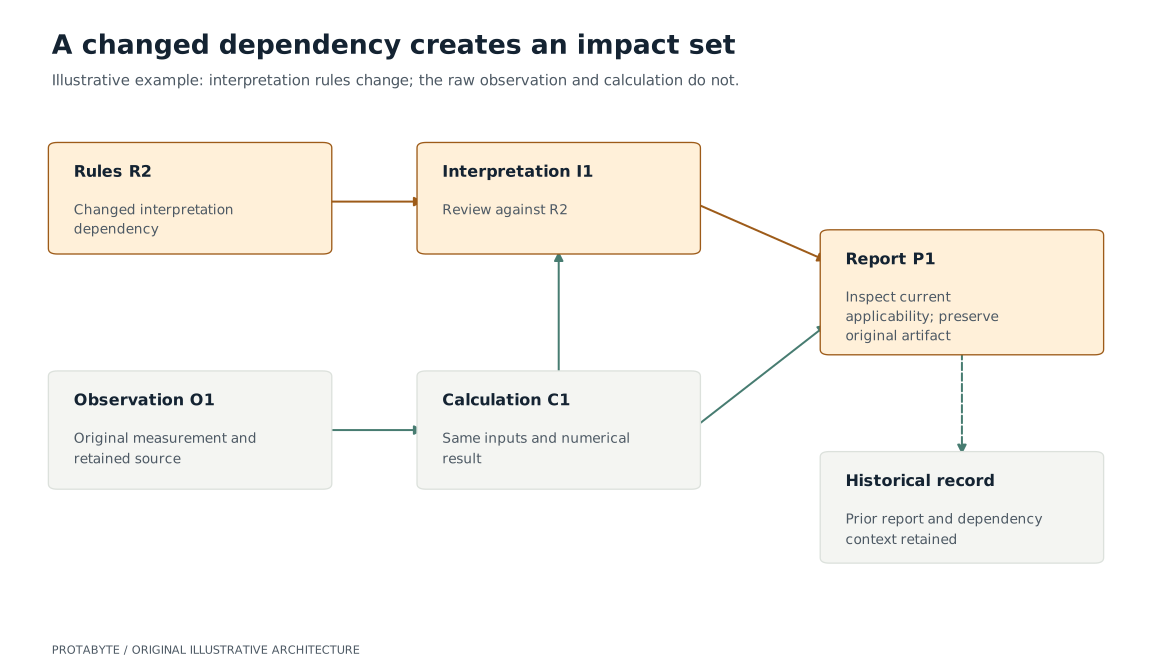
A dependency walk can identify I1 and P1 as candidates for examination. That is a useful computational result. It is still only a candidate impact set. The next step depends on what R2 changed and the commitments made by the report.
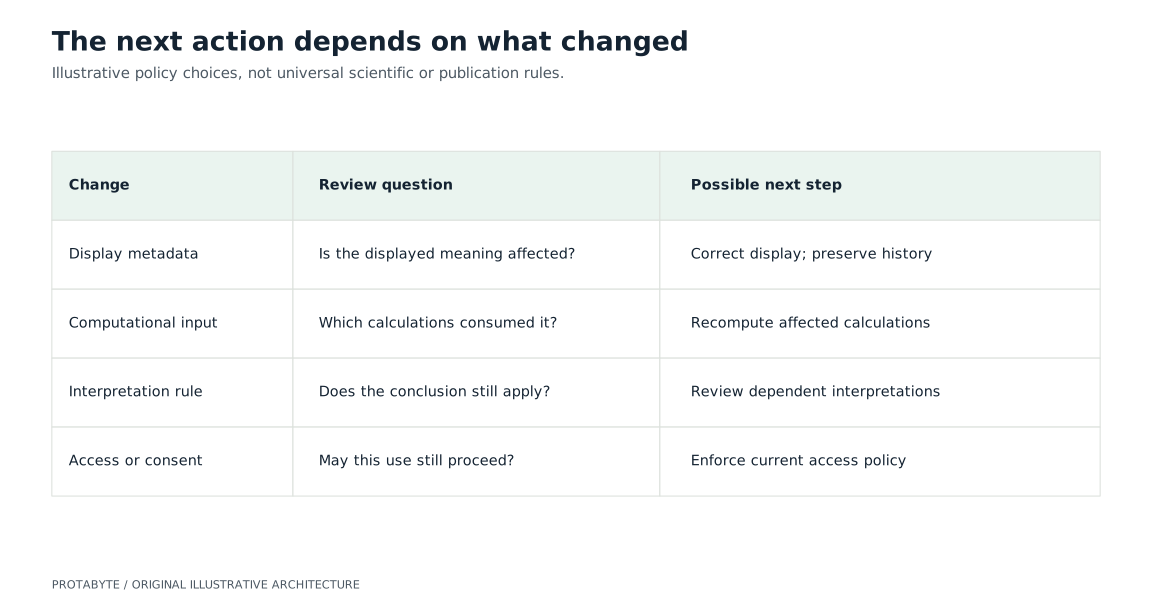
A display-only correction may require a revised label. A changed computational input may require recalculation. A changed interpretation rule may require domain review. A withdrawal of permission may restrict a future use even when every scientific statement remains identical.
A good impact process retains the reason an item entered the queue. “Depends on rules R1, superseded by R2” is more useful to a reviewer than “stale.” It gives them a concrete question and a place to inspect the change.
Separate impact detection from disposition
An application should avoid making its graph traversal responsible for scientific judgment. Traversal can establish that a dependency exists. A rule, calculation, or qualified review determines the significance of the change for the intended use.
That separation makes the workflow easier to test. The same dependency engine can correctly identify two reports even when one needs an amendment and the other needs no action. The disposition records the reasoning that distinguishes them.
It also prevents a common source of unnecessary work. If every upstream edit triggers every downstream computation, a growing reference collection can create a large queue of changes with no effect on users. That queue consumes review capacity and can conceal the few updates that matter.
Conversely, detecting changes only when a displayed number differs can miss significant changes in meaning. Two interpretation versions may produce the same label under different evidence. A source identity correction can change the subject of a statement without changing the statement's numerical payload.
The disposition model should therefore be able to express at least: examined with no relevant effect, recomputation required, review required, a revised output published, and use restricted by current policy. The names can differ. The important point is to preserve the reason and the responsible action.
Preserve the issued artifact and explain the current view
A historical report belongs to the history of the transaction in which it was issued. Updating current knowledge should not silently replace that history.
A revised report can refer to the earlier artifact and explain what changed. A current interface can show that a report has been superseded or that part of its interpretation is under review. A historical view can still reproduce the earlier account using the dependencies recorded at the time.
This creates two connected experiences: inspecting what was issued and understanding what applies now. Neither should require remembering a private conversation with the person who handled the correction.
Access deserves separate treatment. Preserving history does not mean every historical artifact remains available to every requester. Current permissions and applicable retention rules govern access. The record of why an output changed and the policy governing who may inspect it are related concerns with different responsibilities.
A useful product design names both owners. Someone must decide what a revised scientific interpretation means for publication, and the application must enforce who may retrieve and use the resulting records.
Test the change process with cases that disagree
The strongest tests make different parts of the workflow disagree in controlled ways.
Start with an upstream record update that has no effect on the fields consumed by the calculation. The system should recognize the new source context without pretending that an output value necessarily changed. Then change a consumed input and verify that the affected computation is identified.
Next, change a rule while holding the observation fixed. Check that interpretation review can proceed without rewriting the raw evidence. Include a recalculation that returns the same value, because equal values do not make the two production records interchangeable.
Operational failures matter as well. A recomputation can fail. A report can already be in review when another update arrives. A reviewer may reject a proposed amendment. A source can disappear after its bytes were retained. The application needs understandable states for those situations, with enough evidence to continue the work.
Acceptance should follow the user's task: can a reviewer identify why an output was flagged, inspect the relevant change, record a disposition, and explain the current account to another person?
Start with the report family that matters most
A first implementation can be deliberately narrow. Select one report family, identify its important reference and interpretation dependencies, and record them when an output is produced. Define the change events that can affect that family and the dispositions its reviewers can make.
Then demonstrate the complete path: retain an issued report, introduce a fictional reference update, find the affected interpretation, review it, and produce an explainable current view. Measure review effort and inspect cases that entered the queue without requiring action.
This is a useful boundary for technical leadership because it connects data architecture to a real operational responsibility. The system can preserve what happened, identify what deserves attention, and carry a justified change through to the people relying on the result.
Protabyte helps teams design scientific data workflows with explicit reference dependencies, review paths, and explainable results. Talk with us about the report family or research workflow your team needs to improve.