
An assistant reads a document that contains a request to alter a record. The document may be useful evidence. It may also contain mistakes, irrelevant instructions, or deliberately hostile text. None of those words establishes who is allowed to change the application.
The same distinction applies to the assistant's response. A coherent explanation can help a person understand a proposed correction. It does not identify the principal whose permissions govern the operation, establish that the record is still in the expected state, or prove that a change committed.
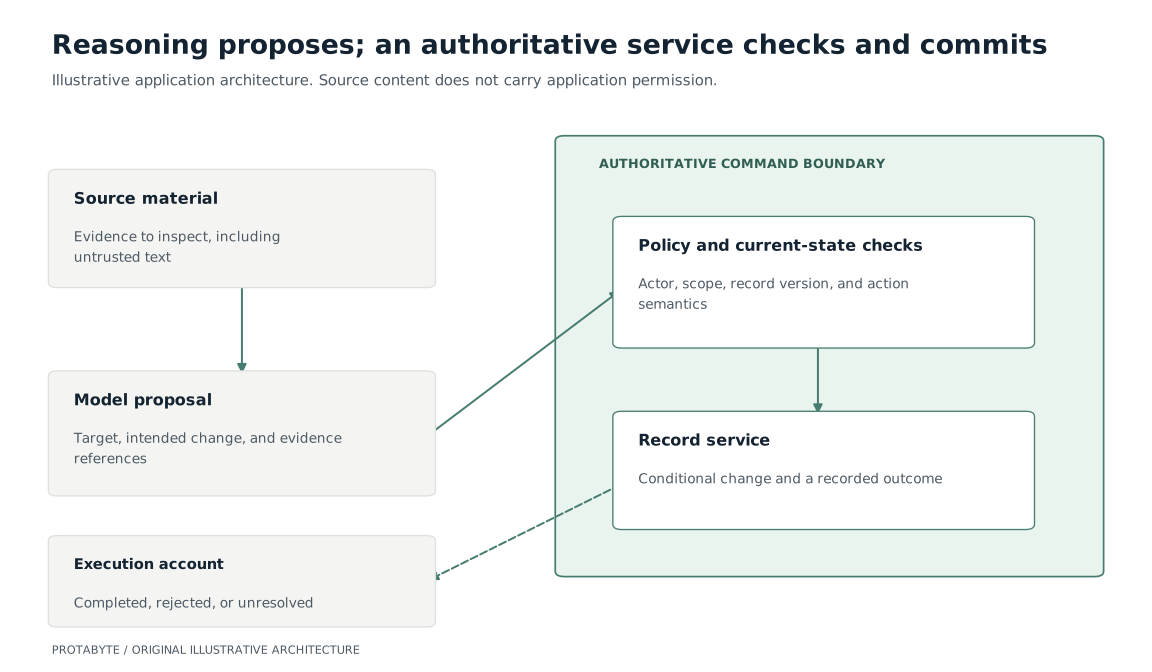
Those responsibilities need a concrete place in the architecture. A useful pattern is to let AI produce an inspectable proposal and require the authoritative service to evaluate the command under current identity, permission, scope, and state. The result should be a recorded account of what happened.
This creates a useful path from reasoning to action while keeping the commitments at each step explicit.
Four objects that should remain distinguishable
A source statement, an interpretation, a proposed action, and an executed operation answer different questions.
The source statement records what was supplied by an identified source. The interpretation explains what that statement may mean in the task's context. The proposal describes a change someone wants to make. The execution account describes the operation the receiving system reports as completed, rejected, or unresolved.
Consider a fictional assistant helping maintain descriptive records. It reads a document, identifies a possible discrepancy, and suggests correcting a field. A reviewer can agree that the discrepancy deserves attention without agreeing to every possible correction. Even after approving a specific correction, the reviewer still needs to know whether the application accepted it.
If these stages share one unqualified object called an answer, the application invites confusion about what has already become authoritative. The interface can be clear only if the underlying state transitions preserve the distinctions.
A typed proposal is a practical bridge. It gives a human reviewer and a record service the same concrete object to examine.
Put enforcement at the service that owns the change
An AI component can recommend a tool or construct a proposed request. The receiving application must still enforce who can perform the operation and under what conditions.
OWASP describes excessive agency in terms of functionality, permissions, and autonomy that allow unexpected model behavior to have damaging effects. Its guidance includes limiting capabilities and enforcing downstream authorization. OWASP Excessive Agency identifies an important failure mode; it does not certify a particular application design.
For the fictional record service, a prompt saying “only change permitted fields” can express an intended behavior. The service's authorization and validation paths need to implement the actual restriction. The same rule should apply when a request comes from a person, an integration, or an AI-assisted interface.
A narrow command API helps. It can expose a specific operation with defined fields and preconditions rather than allow a general-purpose action whose meaning is hidden in generated text.
Give the proposal enough structure to be reviewed
A proposed change needs more than a summary saying that a record should be updated. It should identify the target, the intended operation, the fields or effect involved, and the scope of the request.
It should also carry the context that can become stale: the expected record version, the evidence references used to justify the change, and any relevant expiry or review conditions. Those are illustrative design elements, not a universal schema. The right structure follows the action and the system's authority model.
A proposal that corrects one descriptive field differs from one that merges records or publishes a result. Giving them distinct operations makes their requirements easier to explain and enforce. It also lets the application decline an unsupported operation without having to infer intent from a paragraph.
The review view can then show the proposed difference, the supporting evidence, and any conflicts. A reviewer should be able to see what accepting the proposal would authorize and what would remain unchanged.
This is useful product design as well as security architecture. It makes an ordinary correction easier to understand and investigate.
Current permission and earlier approval are different facts
A proposal can wait. While it waits, the record can change, the user's role can change, or the evidence may no longer apply to the requested operation.
NIST's zero-trust architecture separates policy decision and administration from enforcement. SP 800-207 provides a public architectural reference for that separation. Applying it to an application command boundary is an engineering choice that still requires a precise implementation.
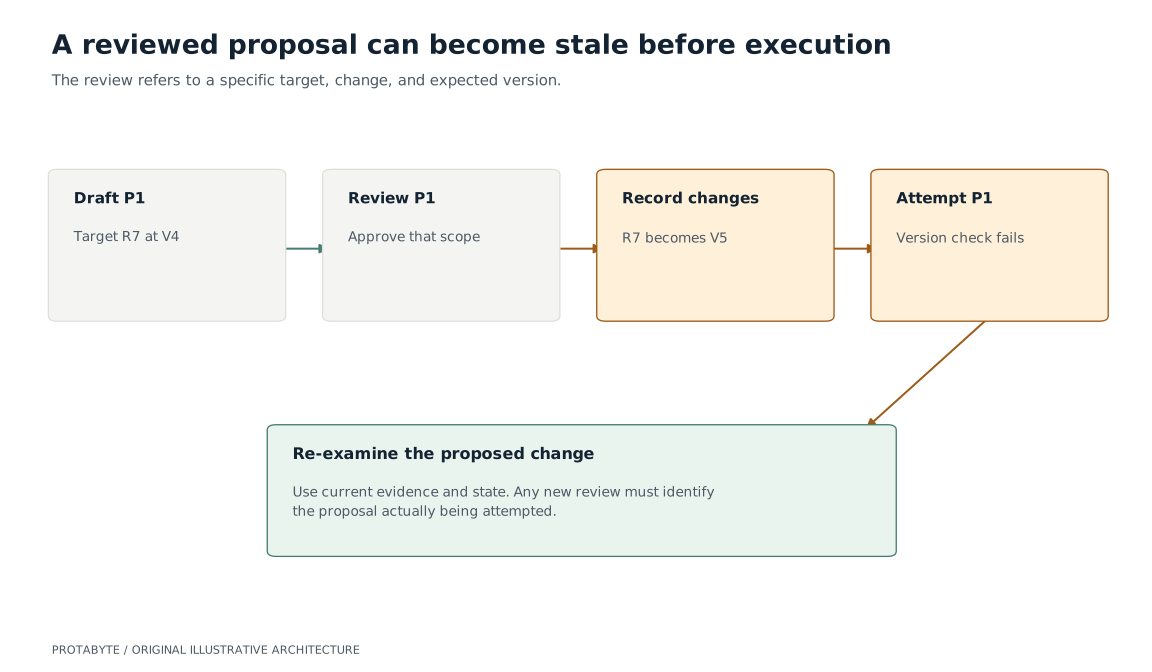
The application should identify which conditions must hold at execution. A reviewer may approve proposal P1 for record R7 at version V4. If the record is now V5, the service needs a policy for that mismatch. For a version-sensitive correction, it can reject the attempt and require the proposal to be reconsidered against the current record.
Permission has a similar time dimension. An actor who was allowed to prepare a change may no longer be allowed to commit it. A retained review record explains the earlier approval; it does not silently replace the current authorization check.
Bind review to the operation actually attempted
A useful approval refers to a concrete proposal and scope. If the application regenerates the proposal, changes its target, or expands its effect after review, it has changed the object the reviewer examined.
The product should make that change visible. It can require a new review, permit only explicitly defined immaterial differences, or reject the modified request. What matters is that the rule is deliberate and enforced at the relevant boundary.
A review record can identify the proposal version or digest it covered, the reviewer, the decision, and the applicable conditions. A digest is useful for comparing the reviewed representation with the attempted one. Its usefulness depends on a defined representation and verification path; hashing a summary is insufficient if the executed command can differ underneath it.
The review experience also needs enough context to make the decision workable. Showing a large generated explanation without the actual proposed difference forces the reviewer to reconstruct the action. That can create a nominal approval step with little practical control over what follows.
Identify the real concurrency boundary
A service can validate a request and still have a race between checking a condition and committing the change. An interface that reads a record, asks for approval, and later submits an unconditional update leaves that gap open.
Within an authoritative store, a conditional write can bind the expected version to the mutation. The exact mechanism depends on the storage and transaction model. The engineering requirement is to identify which component can make the relevant condition and change part of one enforceable operation.
Distributed systems need a consistency contract as well. Google's published Zanzibar design addresses causal ordering of authorization and object changes. The Zanzibar paper is a useful public example of treating this ordering as an explicit systems concern.
That example does not make every application require the same architecture. It does show why “we checked permissions earlier” is incomplete when permissions and objects can change independently.
For a remote provider, the local application may be unable to make its check and the remote effect atomic. The integration must then identify the provider's preconditions, operation identifiers, receipts, or reconciliation methods. It should describe the residual uncertainty rather than promise an atomic guarantee it cannot enforce.
An execution receipt has a specific meaning
After an operation is attempted, users need a reliable account of its outcome. A timeout can leave the caller uncertain even when the receiver has committed a change. A successful response can still require checking whether the intended object and scope were used.
The execution record should distinguish a rejection, a confirmed completion, and an outcome that remains unknown. Recovery should follow the receiving system's supported contract, including how a repeated logical operation is identified and how its status can be verified.
A receipt can tie the operation to its actor, target, request identity, and resulting version. It gives the team something concrete to investigate. It should not be presented as proof that the supporting evidence was scientifically correct or that the decision was wise.
Those questions require their own evidence and evaluation. Keeping them separate makes each commitment more useful: source history explains inputs, review records explain a decision, and execution receipts explain effects.
Test the boundary with ordinary and adversarial changes
A useful evaluation should begin with the ordinary path: a permitted actor reviews a valid proposal, the expected state is current, and the service records the intended change. Then vary one condition at a time.
Place irrelevant instructions in a retrieved document and verify that they cannot expand the application's permissions. Change the target after review. Request a broader operation than the reviewer accepted. Revoke permission before execution. Update the record between drafting and commit. Lose the acknowledgment after a valid write.
For each case, specify what should happen at the service boundary and what the person should see. A denied operation needs an understandable next step. A stale proposal needs a way to be revised without pretending the old approval covered the new action. An uncertain remote effect needs investigation before an unsafe repeat.
Domain review belongs in the evaluation too. An authorized, correctly executed operation can still produce a poor domain result. Testing the permission boundary and testing the usefulness of the action are both necessary, with different acceptance criteria.
Build a narrow action path before broadening autonomy
A practical first milestone can focus on one valuable action with a clear owner and a well-defined record transition. Make its proposal inspectable, bind review to its scope, enforce current permission and relevant state, and retain an execution account.
Then exercise the path through a stale version, denied permission, changed proposal, and ambiguous outcome. The result should leave the operating team able to explain which action was proposed, who could authorize it, what the service accepted, and what actually happened.
That is the foundation for useful AI-assisted action. The reasoning can be flexible and exploratory while the application's commitments remain concrete, inspectable, and enforceable.
Protabyte works alongside teams building AI features that can take useful, governed actions. Talk with us about a focused architecture assessment or an engineering engagement around one concrete workflow.